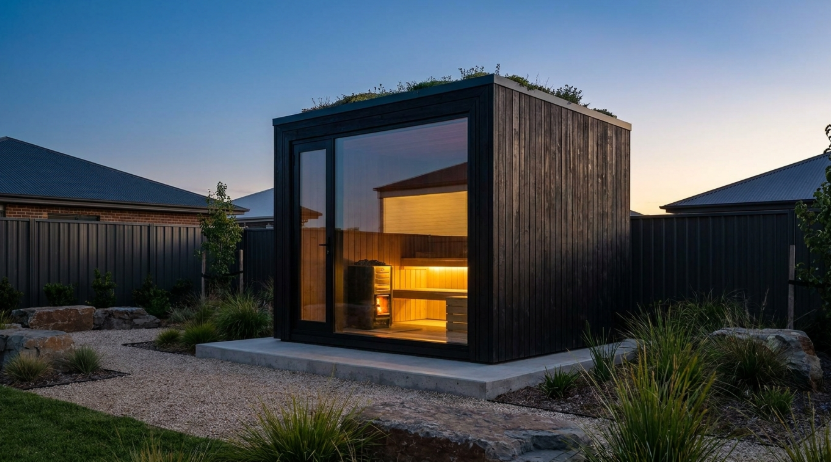
When a standard 6 by 8 foot cabin sauna will not fit a yard or deck, the realistic options are a compact corner-footprint cabin built on a 4 by 4 or 4 by 5 foot base, a narrow-depth cabin designed for deck rails, or a two-person indoor infrared cabin that plugs into a regular outlet. Each trades something for the smaller footprint, whether that is bench capacity, humidity level, or the wood-fired ritual of a true steam sauna, so the right pick depends on what matters most to the household.
What Actually Counts as “Won’t Fit”?
Before ruling out a cabin sauna entirely, it helps to separate two different problems. One is a genuine footprint constraint, a side yard that is 5 feet wide or a deck corner that only has a 4 by 4 foot clear pad. The other is really a budget or electrical constraint dressed up as a space problem, where a homeowner assumes a cabin needs more room than it does because they are picturing a six-person family model. A compact two or three-person cabin has a real footprint of roughly 16 to 20 square feet, smaller than many people expect once they see actual dimensions rather than the largest catalog photo.
Option 1: A Compact Corner-Footprint Cabin
Several manufacturers, including Almost Heaven and Dundalk Leisurecraft, build corner-fit cabin models with an angled or trapezoidal base designed to tuck into an L-shaped yard corner without wasting the unused triangle of space a square cabin leaves behind. These units keep the kiln-dried tongue-and-groove wall construction and low-and-high bench layout of a full-size cabin, just scaled to two or three occupants. The tradeoff is bench length: a compact cabin usually offers one contoured bench per side rather than a full wraparound, so users sit rather than fully recline.
Option 2: A Narrow-Depth Cabin Built for a Deck Rail
For a deck that runs long but is shallow, a narrow-depth cabin, often 4 feet deep with a 6 or 7-foot bench run, uses the length of the deck instead of a square footprint. This keeps more of the interior volume a full cabin sauna needs for proper heat stratification between the low and high bench, which matters because a cabin that is too shallow front-to-back can put the heater dangerously close to a seated occupant’s legs. Manufacturer clearance specs, not eyeballing, should decide whether a given depth works with a given heater.
Option 3: A Two-Person Indoor Infrared Cabin
When even a compact outdoor cabin cannot be sited, an indoor infrared cabin is the most common fallback. These use carbon or ceramic heating panels instead of a heated-rock stove, run on a standard 120-volt outlet with no dedicated circuit required, and fit in a basement corner, garage bay, or spare room closet. The experience is different from a true cabin sauna. Infrared panels heat the body directly at a lower ambient air temperature, typically 120 to 150 degrees Fahrenheit versus 170 to 190 for a wood-lined steam cabin, and there is no water-on-stones humidity or löyly. For someone who specifically wants that steam-room feel, an infrared cabin is a compromise, not a direct substitute.
What to Check Before Buying Any Compact Model
Regardless of which format wins out, three checks matter more on a compact unit than a full-size one, because there is less margin for error. First, confirm the heater’s required clearance from the bench and from any combustible wall behind it, since manufacturers publish exact inch measurements and a compact cabin has less room to spare. Second, check the roof pitch on any outdoor unit sheds water away from a house foundation or fence line rather than pooling against it. Third, confirm the panel wood is kiln-dried rather than air-dried; kiln-dried stock has a lower and more consistent moisture content, which matters even more in a small enclosure where humidity swings happen faster than in a larger cabin. Buyers comparing specialty options side by side, including Sweat Decks, tend to find that pricing on compact models runs $2,800 to $5,500 depending on wood species and heater size, versus $6,000 and up for a full family cabin.
How Much Electrical Work Does a Compact Cabin Need?
A compact two-person cabin often pairs with a 4.5 to 6 kilowatt heater, which can sometimes run on a 30-amp 240-volt circuit rather than the 40 or 50-amp service a larger heater needs. That is a real cost saving on the electrical side, but it is not guaranteed. Distance from the breaker panel, whether the panel has spare capacity, and local code all affect the final number, so a licensed electrician’s quote before ordering is still the only way to know the true cost rather than assuming a smaller heater automatically means a cheap hookup.
Is a Smaller Sauna Still Worth Using Regularly?
The size of the cabin has little to do with whether regular use pays off. A large Finnish cohort followed for over 20 years associated sauna sessions four to seven times a week with meaningfully lower rates of fatal cardiovascular events compared with once-weekly bathing, and a 2018 review in Mayo Clinic Proceedings summarized similar cardiovascular associations across multiple studies. None of that research ties the benefit to cabin size. A compact two-person unit used four times a week is a better bet than an oversized cabin that sits empty because it never quite fit the yard to begin with.
How to Measure the Space Correctly Before You Order
A surprising number of returns and change orders trace back to a measurement taken in a hurry. Start with the clear, level pad area, not the total yard or deck size, and subtract at least 12 inches on every side the cabin will not sit flush against a fence or wall, since that gap is needed for airflow around the vents and for basic maintenance access to the siding. Measure the door swing separately from the footprint; a cabin door typically needs 24 to 30 inches of clear arc to open fully, and a corner installation can put that swing right into a walking path if it is not checked ahead of time.
Weighing the Tradeoffs Side by Side
None of the three options above is strictly better than the others; each answers a different version of “won’t fit.” A compact corner cabin keeps the wood-fired experience at the cost of bench capacity. A narrow-depth deck cabin keeps more bench length but needs a longer, shallower site. An indoor infrared cabin solves almost any space problem but trades steam and löyly for direct radiant heat. Buyers unsure which tradeoff fits best are better off starting with the site measurements and letting the numbers rule options out.
Frequently Asked Questions
What is the smallest footprint a cabin sauna can have? Compact corner-fit models built for two people typically use a 4 by 4 or 4 by 5 foot footprint, and some makers offer angled corner units for L-shaped spaces.
Is an indoor infrared cabin a good substitute for a cabin sauna? It can be for heat and sweat, but it runs cooler and drier, without the humidity or löyly of a true wood-lined cabin.
Can a narrow deck still fit a cabin sauna? Yes, narrow-depth models built for deck rails exist, often 4 feet deep with a longer bench run, though door swing clearance still needs checking.
Do smaller cabin saunas need less electrical work? Usually, since compact heaters can sometimes use a smaller circuit, but a licensed electrician should confirm the actual load before ordering.
What should I check before buying a compact cabin sauna? Heater clearances from the bench and walls, roof pitch for drainage, and kiln-dried rather than air-dried wall panels.
References
- Cardiovascular and Other Health Benefits of Sauna Bathing: A Review of the Evidence, Mayo Clinic Proceedings, 2018
- Benefits and risks of sauna bathing, The American Journal of Medicine, 2001
- Effects of heat and cold on health, with special reference to Finnish sauna bathing, American Journal of Physiology, 2018
By Nathan Pierce